

On Palestinian Resistance
Can you support Palestine without supporting its resistance organizations?

On October 7th, 2023, observers across the world witnessed something that had only a day before seemed near impossible: an act of decolonial violence which would soon set the region ablaze in the 1948 territories of Palestine. The success of the Al Aqsa Flood operation undertaken by Hamas and other Palestinian resistance factions saw the liberation, if even temporary, of land that had been under Israeli occupation for decades.
In what could be described as a daring prison break, the day saw Palestinians returning to their ancestral land, feeling their homeland under their feet for what was for many the first time in their lives. They did so under the protection of resistance factions who quickly spread across the area to capture and eliminate Zionist military positions, disrupt life in settlements that had long been integral parts of the larger Israeli securitization network in historic Palestine, and secure numerous prisoners of war and other captives to lay the groundwork for eventual prisoner exchanges and create leverage that might help negotiate a cessation of hostilities between the colonized and their now stunned occupiers.
Israelis reacted as one might expect, with genocidal violence. The image of invincibility they had cultivated for so long was shattered in a matter of hours. They had spent decades managing a total air, land, and sea blockade against Gaza, tightly controlling what was able to enter and exit the strip. They had turned a land of over two million people, most of them being refugees internally displaced by previous genocidal campaigns, into a concentration camp that they regularly bombarded in actions they described as “mowing the lawn”.
Zionist efforts in the years prior had been incredibly violent, to say the very least. As in the cases of other settler colonial projects, as initial settlement efforts transformed into a more concrete political project, the settlers began their hyperfixation on securitization, deeming Palestinians an existential threat that ultimately must be destroyed in all forms but nostalgia and replaced with a new society that they stood atop the hierarchy of.
The foundational violence of the project predates the official formation of “Israel” itself. As I have outlined in previous pieces, Palestinians experienced mass colonial violence that quickly became the status quo for the settler project as it concretized and matured. By 1929, around a fifth of Palestinian peasants had already been made landless as a result of colonial activity. It is in this context that Palestine’s indigenous inhabitants began organizing resistance to these ongoing efforts.
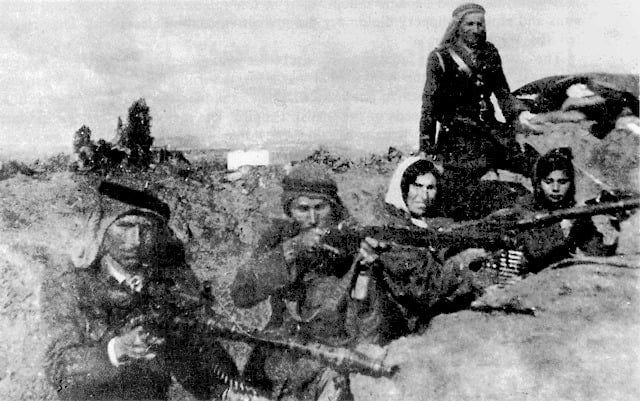
Sporadic Palestinian resistance began in earnest relatively early, as they began putting together what would become increasingly organized efforts to push back against Zionist colonialism. When Palestinians rose up en masse in the Great Revolt of 1936-1939, they were brutally suppressed by British and Zionist forces, but a national consciousness had been awakened that could not be contained by the threat of bombs and bullets. Soon, Palestinian resistance organizations came to life.
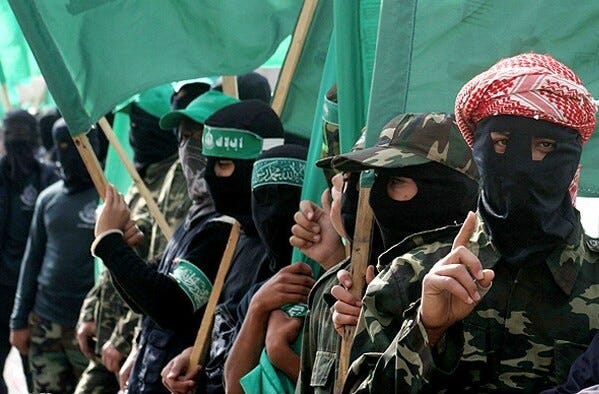
The names of these organizations many know at this point, including Fateh, Hamas, the Popular Front for the Liberation of Palestine (PFLP), the Democratic Front for the Liberation of Palestine (DFLP), Palestine Islamic Jihad, and others. No matter their political and strategic differences, the stories of their formation come from the same thread of resistance to colonial occupation. Over the next decades, these organizations took up the mantle of resistance, competing with each other for the support of the Palestinian people while taking up arms against the Zionist entity.
This would spark a cycle of violence perpetuated by the colonial entity, which put increasing pressure on populations across the region that it wished to subjugate and, if possible, annihilate in the name of territorial acquisition and security. In response, Palestinians would take up arms and deploy violence all their own in the name of liberating their homeland. As one shifted its tactics, so too did the other; both parties engaged in a prolonged war for supremacy and control of the land of Palestine.
It is in this context that the actions of October 7th occurred, with Palestinian resistance forces engaging in armed struggle against a colonial occupation from within the confines of a concentration camp that many had never stepped outside of. This context was seemingly irrelevant to many, however, as almost immediately every person deemed even a lukewarm supporter of Palestinian liberation was bombarded with a simple yet insidious question: “Do you condemn Hamas?”
I have attempted to tackle the complete absurdity of this question in previous works. In short, it was a bad faith question aimed at ensuring allies of the Palestinian cause would disavow those giving their lives on the ground in the name of their liberatory project:
The question of whether we condemn Hamas is more than just a question of condemnation. At its core, we are being asked to disavow decolonial violence altogether — to support Palestinians only when they are perfect victims or only when the groups waging liberatory struggle align with the values of our ideologies and fraternal parties. It is a question that acts as a trap and misses the point entirely.
We cannot make the mistake of engaging seriously with such an obfuscation. It is on us, especially those of us on the Left, to understand that the core driver of the violence we are seeing is and always has been Zionist settler colonialism. This cycle of violence is perpetuated not by the colonized, as they seek to liberate themselves from the state of total subjugation and brutal reality of genocidal liquidation, but by the Zionist project and those advancing its interests.
The question we have to ask ourselves, and indeed answer, is not whether we condemn Hamas, but whether we condemn a settler colonial regime that makes armed struggle necessary for survival.
Unfortunately, this reality has not stopped many from falling for the trap laden in this and other related questions. It would seem that for some, the idea of supporting oftentimes demonized Palestinian and other regional resistance formations is a difficult line to cross. It has become easy for many to attempt to separate those fighting for their survival on the ground from the broader cause of “solidarity” with the Palestinian people. The freedom of Palestinians in a vacuum is upheld, but the means by which they achieve such freedom is demonized.
Worse yet, many so-called advocates for Palestinian liberation have fallen back on the same crude, oversimplistic, or outright wrongheaded condemnations of armed resistance in Palestine that would find a comfortable home in the writings and rhetoric of their Zionist “opposition”. Hamas and other groups are framed as an obstacle to peace who need to be reigned in and disarmed for the sake of a peace process that functionally resembles more of a final solution for the Palestine liberation struggle. Their resistance is consistently centered as the force perpetuating the cycle of violence unfolding in Palestine, as if the Zionist project is simply a force detached from history, forever responding to aggression that it conveniently has no role in whatsoever, even if its methods are detestable.
It becomes clear very quickly that this separation of resistance organizations from the struggle they are active participants in is, at best, fantastical. One might ask what struggle would exist if Palestinians had disarmed themselves in years past. Would a colony hellbent on the annihilation of a people suddenly gain a conscience should its victims be helpless? Would Palestinians be safer if Zionists could roam the streets of their communities unimpeded and emboldened by their invincibility? As I have previously argued, the armed struggle for Palestinian liberation is the lifeblood of the struggle itself:
That armed struggle, a material necessity, is reaping material results, even in spite of mass violence, crackdowns, and a campaign of outright genocide. In Gaza specifically, that very struggle in no small part led to the withdrawal of Zionist settlers from the territory which forced Zionist planners to rework how they went about their occupation of Gaza. The struggle has kept Israeli Occupation Forces from entering Jenin and other refugee camps across historic Palestine without serious consequence. In many ways, the resistance struggle has been a key element of continued Palestinian survival.
When one realizes this, it becomes clear that one cannot separate the resistance from the larger struggle. They are the struggle, its physical manifestation, and those preserving it every single day through their actions. Condemnations then of the resistance not only miss the mark, but undermine the struggle itself, aiding in the demonization of those men and women who have put their lives on the line for the sake of their movement.
It is perhaps uncomfortable for some to stand with the oppressed when they are no longer perfect victims, but history has shown us that these “imperfect” souls are those who will achieve their liberation. The past decades have been littered with examples, such as the FLN in Algeria, the IRA in Ireland, the ANC in South Africa, SWAPO in Namibia, and beyond. These are all organizations that were demonized, framed as terrorists hellbent on violence. However, in all of these instances, they were simply individuals who organized amongst themselves to fight for a future they knew well they might not see, in which their people were free from colonial tyranny.
One does not have to answer the unserious questions aimed at securing our complicity in the oppression of those fighting on the ground for their people. It is easier to ask those who might pose such a question if they accept the colonial status quo in which millions remain displaced, tens of thousands lay dead, and millions more remain at risk of violence and displacement every single day of their lives. It is critical, however, that should we choose to respond, we choose to stand with those abroad who ensure the struggle for the liberation of Palestine remains alive well after they should leave this existence.
very true perspective. freed from the ideological veil.
thank you, great article